Must-See Attractions in Milan: The Best Places to Visit
Gothic architecture, Renaissance masterpieces, historic neighbourhoods and new skylines: Milan offers very different experiences, even to those who visit for just a few days. This guide brings together the best places to visit in Milan to help you choose what best suits your interests and the time you have available.
Milan attractions at a glance
Churches and basilicas
Milan Duomo, Basilica of Sant’Ambrogio, Basilica and Colonne of San Lorenzo
About 1 hour (Duomo 1–2 hours, basilicas 30–45 minutes each)
Palaces, castles and architecture
Galleria Vittorio Emanuele II, Castello Sforzesco, Porta Nuova
About 1 hour (Galleria 20–30 minutes, Porta Nuova about 1 hour, Castello 1.5–2 hours)
Museums and art
Leonardo’s Last Supper, Brera and the Pinacoteca, Museo del Novecento, Leonardo da Vinci National Museum of Science and Technology, Cimitero Monumentale
About 1.5 hours (from 45 minutes for the Last Supper to 2–3 hours for the Science Museum)
Neighbourhoods and atmosphere
Navigli, Quadrilatero della Moda, Isola, CityLife, Tortona
About 1–1.5 hours (Navigli about 1 hour, Tortona 1–3 hours depending on the museums)
Historic theatres, performance and sport
Teatro alla Scala, Piccolo Teatro, Teatro Dal Verme and Teatro Carcano, San Siro Stadium
30–60 minutes for the Scala museum and the San Siro tour; the other theatres depend on the performance.
Things to see in Milan for the first time
If it is your first time in Milan, these are the places to visit in Milan worth including in your itinerary to get to know the city’s different sides:
- Art and culture: Leonardo’s Last Supper, one of the most famous masterpieces kept in Milan and best booked in advance, the Pinacoteca di Brera, one of the city’s main art collections, and Teatro alla Scala, a symbol of Milan’s cultural and musical tradition.
- Architecture: the Duomo and Galleria Vittorio Emanuele II, the ideal starting point for discovering Milan’s monumental heart, Castello Sforzesco, for its history and museums, and Porta Nuova, to see the contemporary face of Milan among skyscrapers and new architecture.
- Atmosphere: the Navigli, to stroll along the canals and through the streets of the district, and the Brera district, with its historic streets, palaces and venues.
If you would rather organise your visits into a route already divided by day and area of the city, see What to Do in Milan in 3 Days: A Complete Itinerary.
Want to explore each stop in more depth? The sections below group the attractions by theme, with what to see and practical tips to plan your visit around your interests and time.
Churches and Basilicas
Milan’s churches tell some of the oldest chapters of the city’s story. Alongside the Duomo, the basilicas of Sant’Ambrogio and San Lorenzo reveal Milan’s Roman, early Christian and medieval origins.
Milan Duomo
Begun in 1386, the Duomo is one of the must-see attractions in Milan, dominating the centre of the city with its 135 spires and more than 3,400 statues. Besides the cathedral itself, visitors can explore the Duomo Museum and the rooftop terraces, with separate or combined tickets.
Don’t miss: the statue of St Bartholomew Flayed, the brass meridian line set into the floor and the Archaeological Area with the remains of the early Christian baptistery.
Plan your visit: for a first visit, combining the cathedral with the terraces offers the most complete experience: allow roughly one hour for the cathedral and about two with the terraces. Entrances are generally available every day, but opening hours can vary because of religious celebrations, events or weather conditions. Metro: Duomo, M1 and M3.
Basilica of Sant’Ambrogio
Founded by Saint Ambrose between 379 and 386 and rebuilt in the Romanesque style between the eleventh and twelfth centuries, it is one of the most representative places of medieval Milan. The arcaded atrium, the brick façade and the two bell towers create an atmosphere very different from that of the monumental centre.
Don’t miss: the golden altar, the apse mosaics, the Sacello di San Vittore in Ciel d’Oro and the Ambrosius museum route, dedicated to the basilica’s treasure.
Plan your visit: tourist visits are normally possible Monday to Saturday, 10:00–12:00 and 14:30–18:00, and on Sunday 15:00–17:00, when no services are under way. Metro: Sant’Ambrogio, M2 and M4.
Basilica and Colonne of San Lorenzo
The sixteen Roman columns in front of the basilica form one of the most recognisable scenes in Porta Ticinese. Behind them, San Lorenzo Maggiore preserves the layout of one of Milan’s most important early Christian buildings.
Don’t miss: the Chapel of Sant’Aquilino with its late-antique mosaics, the statue of Constantine and the nearby Parco delle Basiliche.
Plan your visit: around 30–45 minutes are enough. From here you can continue on foot along Corso di Porta Ticinese towards the Darsena. Tram 3, Colonne di San Lorenzo stop.
Palaces, Castles and Architecture
Milan combines Renaissance buildings, nineteenth-century arcades and contemporary towers. These three stops cross different centuries of the city’s history and urban transformations.
Galleria Vittorio Emanuele II
Designed by Giuseppe Mengoni and opened in 1867, the Galleria Vittorio Emanuele II connects Piazza del Duomo with Piazza della Scala. The shop windows, the decorations and the glass dome make it much more than a shopping street.
Don’t miss: the lunettes dedicated to the continents, the historic shop signs and venues such as Camparino.
Plan your visit: the Galleria is a public passage and can be crossed at any time. Early morning and evening are generally quieter. Metro: Duomo, M1 and M3.
Castello Sforzesco
From Visconti fortress to Sforza court, the Castello Sforzesco, one of the must-see attractions in Milan, has lived through many phases of the city’s history. Today it houses museums and cultural institutions, while the courtyards are freely accessible.
Don’t miss: the Museum of Ancient Art, the Pinacoteca, the Ancient Egypt Gallery and the Museum of Musical Instruments.
Plan your visit: the museums are open Tuesday to Sunday, 10:00–17:30, with last entry at 16:30. The courtyards are open every day, 7:00–19:30. The Sala delle Asse is currently closed for restoration, while the Merlate follow specific calendars and access arrangements. Metro: Cairoli, Cadorna or Lanza.
Porta Nuova
Porta Nuova is one of the places to visit in Milan for contemporary architecture, built where railway yards once stood. Designed by César Pelli, the UniCredit Tower rises 231 metres and is the tallest building in Italy, dominating an urban landscape very different from the historic centre.
Don’t miss: the UniCredit Tower, the glass-and-concrete Fondazione Feltrinelli building by Herzog & de Meuron and, for another view of the skyline, the Belvedere on the 39th floor of Palazzo Lombardia, which opens to the public only on selected days and with advance booking. Stefano Boeri’s Bosco Verticale, completed in 2014, can only be admired from the outside, because the towers are private residences.
Plan your visit: the area is easy to explore on foot in about an hour. Metro: Garibaldi FS, M2 and M5, or Gioia, M2.
Museums and Art
From Renaissance masterpieces to twentieth-century avant-gardes, Milan offers museums that are very different from one another. Besides the great art collections, there is room for the history of science and technology and even an open-air museum.
Leonardo da Vinci’s Last Supper
Leonardo created the Last Supper between 1495 and 1498 in the refectory of Santa Maria delle Grazie. The experimental technique he used has made the painting extremely fragile, which is why admissions are limited.
Don’t miss: the perspective construction, the apostles’ reactions and Giovanni Donato Montorfano’s Crucifixion on the opposite wall.
Plan your visit: the time in front of the work lasts 15 minutes and booking is mandatory. Visitors are asked to arrive 30 minutes early with an ID matching the name on the ticket. Metro: Conciliazione or Cadorna.
Brera and the Pinacoteca
The Pinacoteca di Brera, founded in 1809 inside Palazzo Brera, is one of Italy’s most important painting collections: it lets visitors travel through several centuries of Italian painting on a route that is easy to complete in a couple of hours.
Don’t miss: Raphael’s Marriage of the Virgin, Mantegna’s Dead Christ, Caravaggio’s Supper at Emmaus and Hayez’s The Kiss.
Plan your visit: the Pinacoteca is open Tuesday to Sunday, 8:30–19:15, with last entry at 18:00. Booking is required, and the ticket also includes Palazzo Citterio, which can be visited on the same day or within the following six days. Metro: Lanza or Montenapoleone.
Museo del Novecento
Overlooking Piazza del Duomo, the Museo del Novecento tells the story of Italian art of the twentieth and twenty-first centuries. The route combines artworks, architecture and close-up views of the cathedral.
Don’t miss: Futurism, the rooms dedicated to Morandi and de Chirico, and Lucio Fontana’s neon.
Plan your visit: open Tuesday to Sunday, 10:00–19:30, and until 22:30 on Thursdays. Last entry is one hour before closing. Metro: Duomo, M1 and M3.
Leonardo da Vinci National Museum of Science and Technology
Housed in the spaces of a former monastery, it is Italy’s largest science and technology museum. It is particularly suited to families and to those who want to discover Leonardo as an engineer and inventor.
Don’t miss: the Leonardo Galleries, the Enrico Toti submarine, the Luna Rossa catamaran, the Space area and the fragment of Moon rock.
Plan your visit: the museum is open Tuesday to Friday, 9:30–17:00, and at weekends and on public holidays until 18:30. On busier days it is advisable to buy tickets online. Metro: Sant’Ambrogio, M2 and M4.
Cimitero Monumentale
The Cimitero Monumentale is a large open-air museum in which tombs, monuments and sculptures tell the artistic, entrepreneurial and cultural story of Milan from the nineteenth century onwards.
Don’t miss: the Famedio, the Campari chapel and works by artists such as Giannino Castiglioni, Leonardo Bistolfi and Adolfo Wildt.
Plan your visit: open Tuesday to Sunday, 8:00–18:00, with last admission 30 minutes before closing. Guided visits are also available on selected dates. Metro: Monumentale, M5.
Neighbourhoods and Atmosphere
Not all Milan attractions are contained within a museum or a monument. The Navigli, the Quadrilatero della Moda, Isola, CityLife and Tortona reveal very different sides of the city, from the village of case di ringhiera to the design district, simply by strolling.
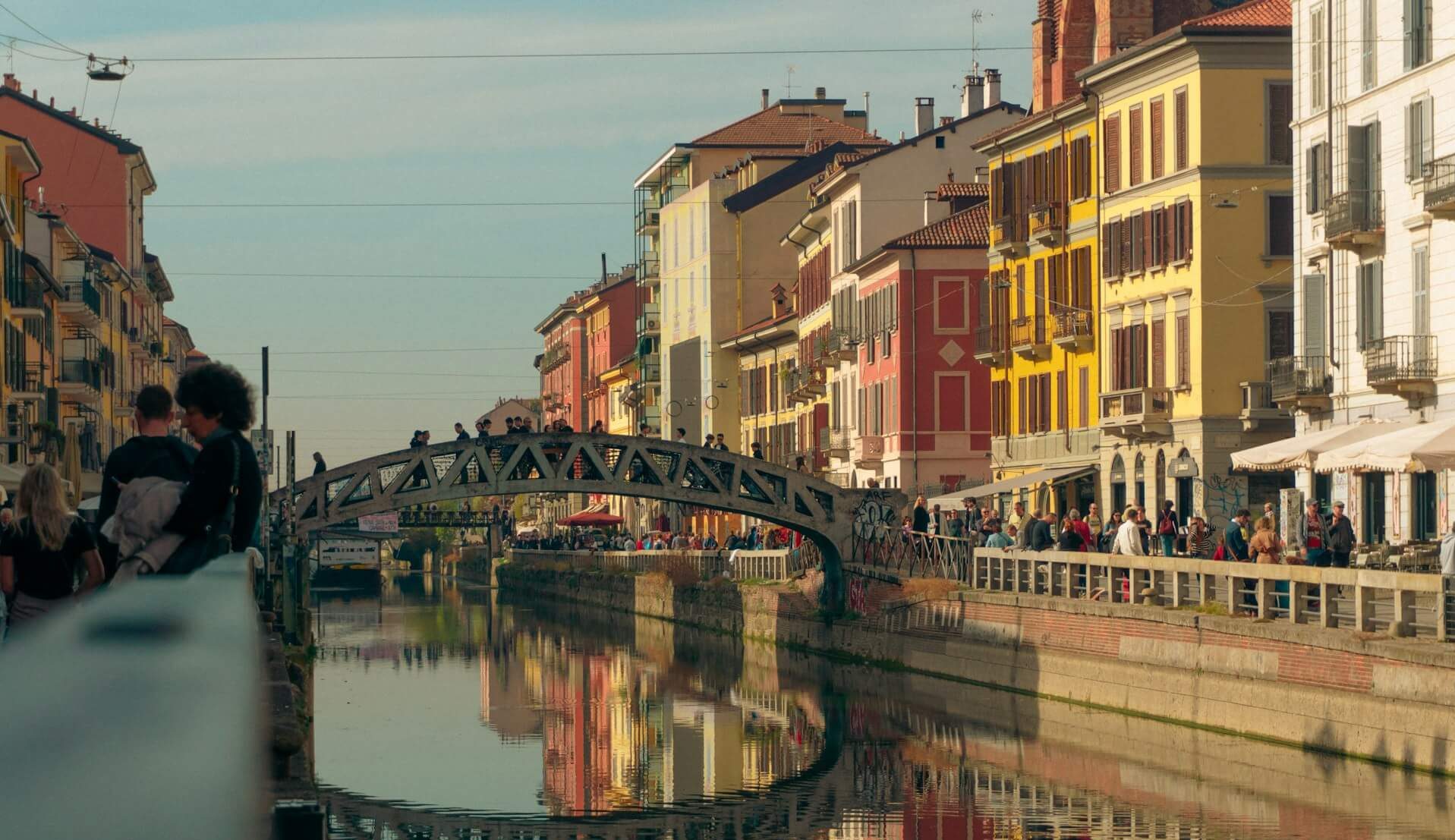
Navigli
The Navigli are what remains of the old network of canals that carried goods, and the marble for the Duomo, into the heart of the city. The Naviglio Grande, dug between 1177 and 1272, still reaches the Darsena, the old port redeveloped for Expo 2015.
Don’t miss: the Darsena, the case di ringhiera and the artisan workshops along the towpath. On the last Sunday of the month the Mercatone dell’Antiquariato antiques market takes place; for a quieter stroll, it is better to choose the morning or a weekday afternoon.
Plan your visit: the most convenient stop is Porta Genova, M2. About an hour is a good estimate, a little more if you stop at the shops and venues along the way.
Quadrilatero della Moda
The Quadrilatero tells the story of Milan’s relationship with fashion and design. Via Montenapoleone and Via della Spiga are the best-known streets, but the area also holds less frequented palaces, museums and courtyards.
Don’t miss: the Poldi Pezzoli Museum, the Bagatti Valsecchi Museum, Palazzo Morando and the historic Caffè Cova.
Plan your visit: metro Montenapoleone, M3, or San Babila, M1 and M4. A stroll along the main streets takes about 30 minutes; if you add a house museum, allow about an hour more.
Isola
The name comes from the isolation caused by the railway tracks, which from the mid-nineteenth century separated the district from the centre: an eighteenth-century map already shows the “Insola de Porta Comasina”. A district that grew up around factories, courtyards and case di ringhiera, Isola still keeps its small-village atmosphere.
Don’t miss: the murals of Via Pepe, including a 250-metre work dedicated to Leonardo da Vinci, the mural dedicated to the étoile Aida Accolla on Via Borsieri and the case di ringhiera around Piazzale Archinto.
Plan your visit: metro Isola, M5, Garibaldi FS, M2 and M5, or Zara, M3 and M5. About 1–1.5 hours are enough; combined with Porta Nuova, it fills a morning.
CityLife
CityLife was built on the site of the former Fiera Campionaria, after the trade-fair activities moved to Rho-Pero. The masterplan is signed by Arata Isozaki, Zaha Hadid and Daniel Libeskind: their three towers, which the Milanese call il Dritto (the Straight One), lo Storto (the Twisted One) and il Curvo (the Curved One), redraw the skyline around Piazza Tre Torri, in a largely pedestrian district.
Don’t miss: the Allianz Tower, topped by a copy of the Madonnina, the park of about 178,000 square metres with the Orti Fioriti gardens, and ArtLine, the open-air public art trail where you can also find Wilfredo Prieto’s Beso.
Plan your visit: metro Tre Torri, M5, with Domodossola FN and Portello nearby. Around 1–1.5 hours are enough for the piazza, the towers and the park, longer if you add some shopping. The Shopping District is generally open from 10:00 to 21:00, until 22:00 on Fridays and Saturdays, but hours may vary.
Tortona
Behind Porta Genova, Via Tortona and Via Savona show how Milan has reinvented its industrial heritage: the former factories, starting with the Ansaldo electromechanical complex, active since 1904, are now museums, studios and showrooms. It is considered the birthplace of the Fuorisalone and keeps its identity as a design district even outside April’s Design Week.
Don’t miss: the MUDEC – Museo delle Culture, designed by David Chipperfield in the former Ansaldo area, Armani/Silos, in the former granary on Via Bergognone that houses the permanent exhibition dedicated to Giorgio Armani, and the Fondazione Arnaldo Pomodoro.
Plan your visit: metro Porta Genova FS or Sant’Agostino, M2, or California, M4. The MUDEC is generally open on Monday from 14:30 to 19:30 and Tuesday to Sunday from 9:30 to 19:30, until 22:30 on Thursdays. Armani/Silos is open Wednesday to Sunday, 11:00–19:00 (last entry 18:00), and closed on Mondays and Tuesdays; booking is recommended. Hours may vary depending on exhibitions. A stroll through the area takes about 45–60 minutes; allow about an hour more for each museum.
Historic Theatres, Performance and Sport
From the city’s historic stages to San Siro, performance, music and sport reveal a different side of Milan’s identity, best discovered by attending a show or a concert, or by going behind the scenes of places that have become symbols of the city.
Teatro alla Scala
Opened in 1778, Teatro alla Scala is one of the world’s most important opera houses. You can discover it by attending a performance or by visiting the Museo Teatrale, from which it is sometimes possible to look out over the auditorium.
Plan your visit: the museum is open every day, 9:30–17:30, with last entry at 17:00, apart from some holidays. Whether the auditorium is visible depends on rehearsals and events. Metro: Duomo, M1 and M3.
Piccolo Teatro, Teatro Dal Verme and Teatro Carcano
Three historic stages show different sides of Milan’s theatre life. Founded in 1947, the Piccolo Teatro was Italy’s first public repertory theatre, with venues at the Teatro Grassi on Via Rovello, the Strehler in Largo Greppi and the Studio Melato. The Teatro Dal Verme, a short walk from Castello Sforzesco, is today mainly a concert hall and home to the orchestra I Pomeriggi Musicali. Active since 1803, the Teatro Carcano offers drama, dance, music and cultural events along Corso di Porta Romana.
Plan your visit: the best way to get to know them is by attending a performance or a concert, so it is worth checking the programme and the venue before booking. Metro: Lanza, M2 (Strehler and Studio Melato), Cordusio, M1 (Grassi), Cairoli, M1 (Dal Verme), Crocetta, M3, or Sforza Policlinico, M4 (Carcano).
San Siro Stadium
Opened in 1926 and named after Giuseppe Meazza, San Siro is the home of AC Milan and Inter. The Museum & Tour allows visitors to see the museum, the dressing rooms, the tunnel and some areas of the stadium.
Plan your visit: the tour takes about an hour and is generally available every day, from 9:30 to 17:00 between November and March and until 18:00 between April and October. On match or concert days the route may be changed or suspended. The Skywalk requires a separate ticket. Metro: San Siro Stadio, M5.
Milan Beyond the Best-Known Places
Beyond the major Milan attractions, the city hides private villas, unusual buildings and small streets that often escape a first visit. The Quadrilatero del Silenzio, with the flamingos of Villa Invernizzi and its Liberty palaces, the Igloo Houses in Maggiolina and the colourful Via Lincoln are a few places worth looking for while strolling, ideal for those who want to discover a more everyday and less monumental side of the city.
Getting to Milan
Air Dolomiti connects Milan with Frankfurt and Munich. To prepare your trip, see the information dedicated to Frankfurt Airport, Munich Airport, Milan Linate and Milan Malpensa.
FAQ
What should I not miss in Milan?
For a first visit, the Duomo, Leonardo’s Last Supper and Castello Sforzesco are three of Milan’s landmark sights. To experience the city beyond its monuments, add time for neighbourhoods such as Brera or the Navigli.
What is the most visited place in Milan?
The Duomo is Milan’s best-known landmark and one of the city’s main visitor attractions. Beyond the cathedral itself, visitors can also explore the rooftop terraces, the archaeological area and the Duomo Museum.
Are 2 days enough to see Milan?
Yes. Two days are enough to see several of Milan’s main attractions, especially if you focus on the historic centre and group nearby sights together. If you have three days, you can explore more neighbourhoods and contemporary areas at a slower pace.
Is Milan a walkable city?
Yes. Milan is easy to explore on foot, especially in the historic centre, where attractions such as the Duomo, Galleria Vittorio Emanuele II, Teatro alla Scala and Brera are relatively close to one another. For areas further from the centre, the metro and tram network makes it easy to continue exploring the city.
