A DAY WITH AN AIR DOLOMITI CAPTAIN

No time like the present to read our blog if you’re a true AvGeek!
We asked ourselves how best to offer exclusive access to areas typically reserved for insiders by spending a day alongside an Air Dolomiti captain: before, during, and after the flight. We have gathered knowledge, information, curiosities, and reflections on flying and aeroplanes. Enjoy!
📍 VRN – 4:52 AM | Two hours before the flight
The day of an Air Dolomiti Captain begins before dawn. This isn't for the sake of romanticism, though some sunrises linger, but because routines require time. In the morning, they follow a set routine: sipping coffee in silence, checking weather updates, and reviewing the flight schedules, even if they already know them. Just like a plane, the mind needs regular routines to prepare for takeoff. Verona's Valerio Catullo Airport is beginning to awaken.
In the early morning light, the headlights of the ramp vehicles emanate an atmosphere of suspense. The captain confirms that visibility will be excellent in about half an hour. However, there is a chance of rain tonight during the last return flight. There's a precise moment when oneself becomes the Captain: everything else dissolves and all senses focus on the plane.
It's a moment that occurs repeatedly but feels different each time. It's when the flight plan is activated. The mind shifts gears; habits turn into protocols, and attention sharpens into focus. In that instant, even before taking off, you already feel airborne.
After the operational briefing with the First Officer and cabin crew, preparations for passenger boarding begin. The first flight of the day is from Verona to Munich, aboard an Embraer 195.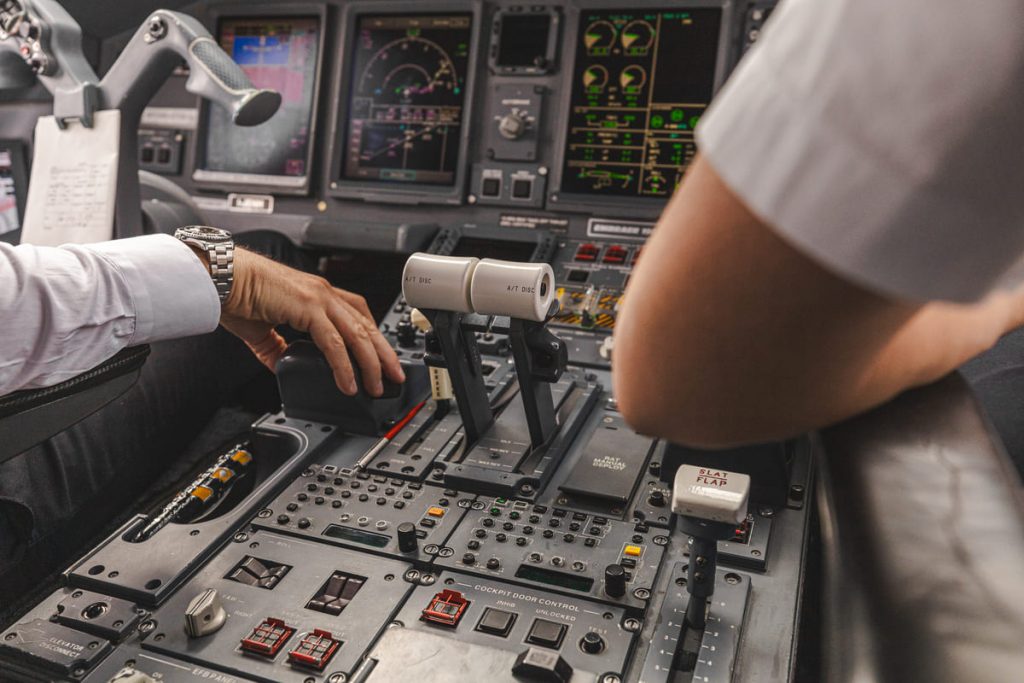 The Embraer 195 is the longest of the E-Jet family. Designed for 122 passengers, it is powered by two General Electric CF34-10E engines, each producing over 20,000 pounds of thrust. The big brother of the Embraer 190, the E195 retains the family's manoeuvrability and agility, while offering a fuselage stretching over 2.5 meters. Both models share a fly-by-wire architecture, integrated Honeywell Primus Epic avionics, and excellent takeoff performance even on runways shorter than 1,800 meters.
They appear tailor-made for European regional hubs, where efficiency, silence, and quick turnarounds are standard.
A day with the Captain: the walkaround
As predicted, visibility is excellent. The marshaller—equipped with a helmet, reflective vest, and light paddles—directs the plane to Gate 4 with a series of codified gestures that resemble a choreography.
The Captain is about to undertake the walkaround, the external inspection of the aircraft that precedes every flight. This is a meticulous and systematic visual procedure, required by the pre-flight checklist and regulated by the operations manuals (OM-A and OM-B), as well as by EASA regulations.
It can be performed by the Captain or the First Officer, depending on the division of duties for the flight, but the responsibility always lies with the Captain.
Walkaround Checklist
- Tail and rear fuselage
Check stabilisers, APU exhaust for any visible leaks or damage. - Lower fuselage
Check panels, fluid leaks, and structural damage. - Wings – trailing edge
Flaps, ailerons, and spoilers: check for integrity, mobility, and obstructions. - Wings – lower section
FOD (Foreign Object Damage), impact marks, leaks, and drain mast inspection. - Landing gear
Tires, brakes, oleo struts, and hydraulic lines. - Engines and air intakes
Nacelles intact, fan blades free of chips, foreign bodies, or leaks.
The walkaround is a relatively slow time in a fast-paced profession. It's the moment when human and machine sync. To understand the aeroplane, you have to listen to it, not just look at it. Of course, experience teaches you where to look and what to listen for, but there’s something to learn every time.
With a 38.65-meter wingspan and a structure designed to optimise fuel consumption and reduce noise, the Embraer E195 demands attention where technology meets the physical force of flight. This is where the Captain simultaneously uses his senses and intuition of someone who has always repeated the same procedures.
On flight
At 6:32, flight EN8207 leaves runway 4. The rotation is smooth. The climb to Flight Level 340 is stable. The Captain exchanges a few words with the First Officer about plans for the evening in Florence.
The cockpit is—after all—the pilots' office. An office at 30,000 feet, moving at 850 km/h, where work is continuous: fuel consumption calculations, performance monitoring, ATC management, and operational communications. The avionics interface is located here, promoting an ergonomic workflow by reducing cognitive load. And here too, now and then, coworkers exchange jokes.
Landing, closure, and as expected... rain | 📍 FLR – 8:15 PM
The last flight arrives on time. And as expected, it rains. Landing at night in the rain requires precision and awareness. Visibility is reduced, and perceiving the height and depth of the runway becomes more difficult. In heavy rain, the windshield wipers are activated, but only below 253 knots, so they are only used during the final approach phase. If the runway is very wet, a positive landing—a firm contact with the ground—is preferred to reduce the risk of aquaplaning. In these conditions, the crosswind limits are also adjusted, becoming slightly more restrictive than on a dry runway. After taxiing and parking, the Captain completes the final ritual: a post-flight check, then a few notes in the Electronic Tech Logbook. It's still raining outside. But inside the plane—and this story—there’s a full sense of today’s discipline and precision.
We thank the Captain for sharing his thoughts and experience with us. To respect his anonymity, we've adapted some details.
What we shared with you in words, you can now experience in images.