A BRIEF HISTORY OF AIRCRAFT SEATS
Comfortable, covered, reclining and strictly equipped with seat belts: modern aircraft seats are small, comfortable, multifunctional armchairs.
Like all other parts that make up an aeroplane, the seats have evolved over time, eventually becoming as we know them today.
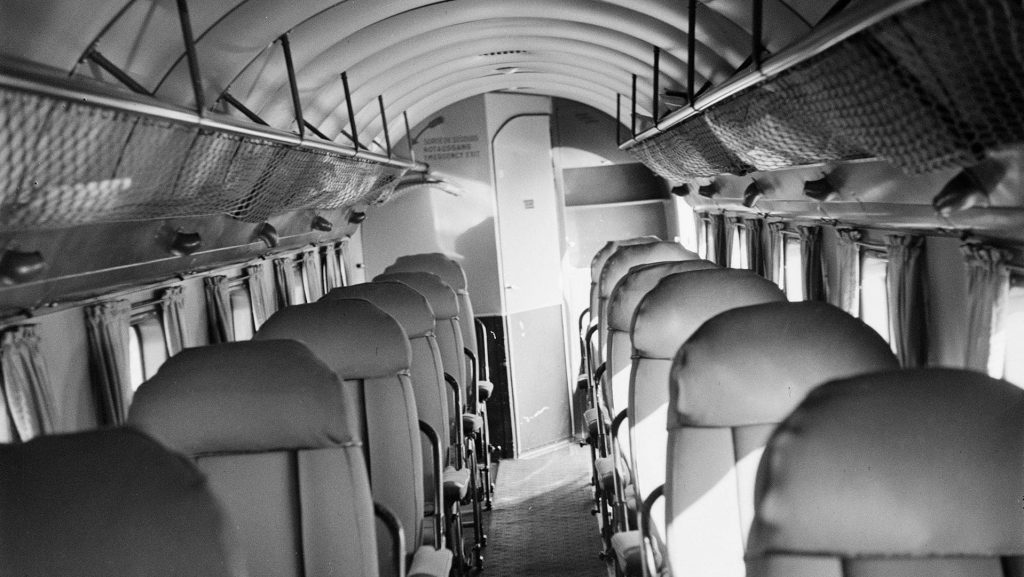 With the increase in demand and the increasingly widespread use of aeroplanes for civil transport, the layout and design of aeroplane seats was adapted accordingly.
In the 1950s, the principles of a new discipline, Ergonomics, were also taking hold. This put users’/passengers’ needs at the core of the design of home, work and transport environments.
Aircraft interiors were reorganised with new layouts and the seats almost immediately began to be configured as we know today: rows of seats facing the nose and divided by a central aisle. Just like in cinemas.
After World War II, In-Flight Entertainment (IFE) began to appear and films were projected on a screen at the front, between the cabin and the cockpit.
Headphone music connected through the armrests arrived in 1985 and was then replaced by computers integrated into the seats in the new Millennium.
With the increase in demand and the increasingly widespread use of aeroplanes for civil transport, the layout and design of aeroplane seats was adapted accordingly.
In the 1950s, the principles of a new discipline, Ergonomics, were also taking hold. This put users’/passengers’ needs at the core of the design of home, work and transport environments.
Aircraft interiors were reorganised with new layouts and the seats almost immediately began to be configured as we know today: rows of seats facing the nose and divided by a central aisle. Just like in cinemas.
After World War II, In-Flight Entertainment (IFE) began to appear and films were projected on a screen at the front, between the cabin and the cockpit.
Headphone music connected through the armrests arrived in 1985 and was then replaced by computers integrated into the seats in the new Millennium.
The first aeroplanes
As we mentioned in our article on the history of tray tables, during the 1920s and 1930s, aeroplanes started to carry passengers, giving birth to commercial aviation. To start with, aeroplanes were a luxury that few people could afford. The cabins of the first airliners were therefore ‘furnished’ like parlours to satisfy the tastes of their élite passengers, with carpets, wide wicker armchairs and goose feather pillows.More passengers = more seats.
With the increase in demand and the increasingly widespread use of aeroplanes for civil transport, the layout and design of aeroplane seats was adapted accordingly.
In the 1950s, the principles of a new discipline, Ergonomics, were also taking hold. This put users’/passengers’ needs at the core of the design of home, work and transport environments.
Aircraft interiors were reorganised with new layouts and the seats almost immediately began to be configured as we know today: rows of seats facing the nose and divided by a central aisle. Just like in cinemas.
After World War II, In-Flight Entertainment (IFE) began to appear and films were projected on a screen at the front, between the cabin and the cockpit.
Headphone music connected through the armrests arrived in 1985 and was then replaced by computers integrated into the seats in the new Millennium.